Court: Evaluating a Vintage Decorative Serif for Modern Heritage Design
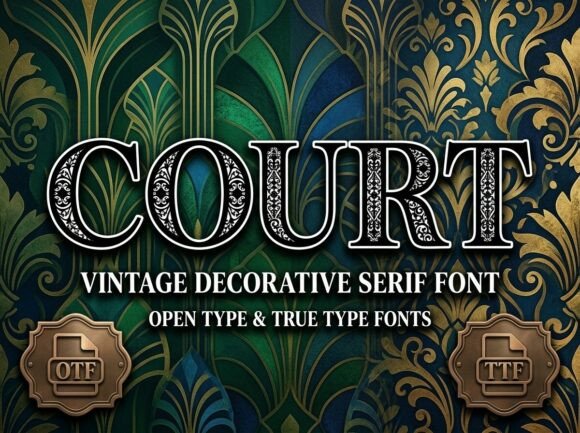
Selecting a typeface that conveys established prestige without appearing dated is one of the most persistent challenges in luxury and heritage branding. Court addresses this specific niche as a vintage decorative serif that integrates intricate interior filigree within a clean, authoritative structure. Unlike standard serifs that rely solely on stroke contrast or terminal shape for character, Court defines its identity through a rhythmic, engraved texture embedded directly into the stems. This architectural depth creates a visual tension between historical ornamentation and modern legibility, making it a distinct option for designers evaluating typefaces for high-end corporate identities, spirit labels, and editorial headers.
For professionals comparing typographic options, understanding where Court fits within the broader landscape of decorative serifs is essential. It is not a general-purpose text face, nor is it a purely ornamental display font. Instead, it occupies a functional middle ground suited for specific applications where texture serves as a primary communication tool. Available in both OTF and TTF formats, Court offers technical flexibility, but its value proposition lies entirely in its aesthetic execution and appropriate application.
Distinguishing Characteristics and Structural Integrity
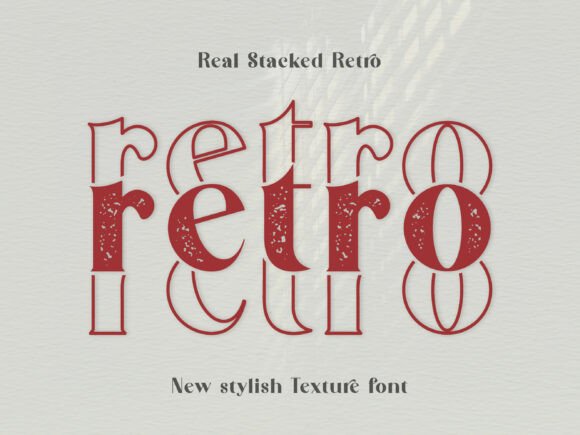
The defining feature of Court is the engraved texture within the letterforms. In many vintage revival fonts, ornamentation is applied superficially or results in heavy, cluttered silhouettes that fail at smaller sizes. Court takes a different approach by maintaining a disciplined outer contour. The serif structure remains sharp and geometric, providing the necessary skeleton for readability. The filigree exists internally, acting as negative space and tonal variation rather than external decoration.
This distinction matters significantly when evaluating alternatives. When comparing Court against standard high-contrast serifs like Didot or Bodoni, the difference is tactile rather than structural. Standard modern serifs achieve elegance through extreme thin-to-thick ratios, which can feel cold or overly fashionable. Court achieves elegance through craftsmanship simulation, evoking the physical process of steel engraving or stone carving. Conversely, when compared to heavily distressed or grunge-style vintage fonts, Court retains a level of polish and vector precision that those styles often lack. It suggests age through design intent rather than artificial degradation.
The "architectural depth" mentioned in its description refers to how the eye perceives weight. Because the stems contain internal patterns, the overall color of the typeface on the page is lighter than a solid serif of the same point size. This optical lightness allows Court to be used at larger display sizes without dominating the layout aggressively, a crucial factor for luxury packaging where white space is as important as the typography itself.
Evaluating Fit: Where Court Excels
Determining whether Court is the right resource requires an honest assessment of the project’s hierarchy and medium. Based on its design attributes, Court performs best in specific scenarios where its unique texture adds semantic value to the content.
- Luxury Spirit and Beverage Labels: The engraved texture mimics traditional intaglio printing and glass etching. For whiskey, gin, or wine labels, Court communicates heritage and artisanal production methods more effectively than a clean sans-serif or a generic script. The texture holds up well against textured paper stocks and foil stamping processes.
- High-End Corporate Identity: For law firms, private banks, or heritage hospitality brands, Court signals stability and tradition. It avoids the sterility of contemporary corporate minimalism while steering clear of the illegibility associated with blackletter or excessive calligraphy. It works effectively as a logotype or for primary headlines in annual reports and stationery.
- Sophisticated Editorial Headers: In magazine spreads or book covers focusing on history, architecture, or fine arts, Court provides immediate contextual framing. The rhythmic texture engages the reader visually before they process the semantic meaning of the words, setting a tone of curated expertise.
- Traditional Signage and Wayfinding: For plaques, directory boards, or exterior signage in historic districts, the font’s structural clarity ensures legibility from a distance, while the interior detail rewards closer inspection. The OTF and TTF availability ensures compatibility with various fabrication software used by sign makers.
Tradeoffs and Limitations in Practical Application
No typeface is universally applicable, and Court has distinct limitations that must be weighed during the selection process. Recognizing these constraints prevents costly redesigns or production issues later in the workflow.
Legibility at Small Sizes: The intricate interior filigree is Court’s greatest strength and its most significant liability. Below 18–24 points (depending on output resolution), the internal details may begin to fill in or create visual noise. Court is strictly a display typeface. It should never be used for body copy, captions, or fine print. If your design requires a matching text face for extended reading, you will need to pair Court with a separate, cleaner serif or sans-serif. This necessitates additional licensing and typographic pairing decisions.
Reproduction Constraints: While the digital files are precise, physical reproduction requires care. In low-resolution web environments or poor-quality offset printing, the fine lines of the engraving effect can break up or moiré. Designers must test Court at the actual intended output size and resolution. For web use, ensuring proper hinting and testing across different screen densities is mandatory. In some cases, a simplified alternate or a solid-weight companion font may be necessary for responsive breakpoints where Court becomes illegible.
Tonal Specificity: Court carries a strong inherent personality. It reads as distinctly European, historical, and formal. It is generally unsuitable for tech startups, children’s brands, casual dining, or any context requiring approachability and modern neutrality. Using Court in these contexts creates cognitive dissonance that undermines the brand message. If the goal is to appear innovative or accessible, alternative categories such as humanist sans-serifs or soft geometrics are more appropriate choices.
Comparative Decision Framework
When researching typeface options, it is helpful to categorize Court against other common solutions to clarify its position. This comparison aids in avoiding the common pitfall of selecting a font based on aesthetic preference alone rather than functional suitability.
| Comparison Factor | Court | Standard Modern Serif | Hand-Lettered Script |
|---|---|---|---|
| Primary Vibe | Engraved, Architectural, Established | Elegant, Fashionable, Sharp | Personal, Artisanal, Fluid |
| Texture Source | Internal Vector Filigree | Stroke Contrast | Natural Stroke Variation |
| Best Scale | Large Display / Headlines | Display to Subhead | Short Titles / Signatures |
| Pairing Requirement | High (Needs neutral text face) | Medium (Often has text weights) | High (Needs structural anchor) |
| Production Risk | Moderate (Detail loss at small sizes) | Low | Moderate (Spacing/Alignment) |
This framework highlights that Court is a specialized tool. If a project requires a single typeface family that spans from billboard to footnote, Court is not the solution. However, if the project demands a specific header treatment that evokes the tangible quality of pre-digital craftsmanship, Court offers a level of integrated detail that would otherwise require custom illustration or post-production texturing.
Technical Considerations for Implementation
For designers moving forward with Court, maximizing its effectiveness involves attention to technical settings. The availability of OTF format is advantageous for professional workflows, as it typically supports advanced OpenType features. Users should check for stylistic alternates or ligatures that may enhance the engraved rhythm or prevent repetitive patterns in longer headlines. Even in display settings, kerning adjustments are often necessary; the complex internal shapes can sometimes create uneven spacing illusions that require manual correction to maintain optical balance.
Color choice also interacts uniquely with this typeface. High-contrast combinations (black on white) emphasize the engraved lines most clearly. However, in luxury applications involving metallic inks or dark backgrounds, the fine lines may need to be slightly thickened or printed with a trap to ensure they remain visible. Testing on the actual substrate is non-negotiable. The interplay between the ink spread and the filigree width determines whether the font looks sophisticated or merely dirty.
Making the Final Selection
Ultimately, the decision to use Court should be driven by the narrative requirements of the project. It is a typeface that tells a story of permanence and meticulous detail. When evaluating it against free alternatives or other commercial vintage revivals, focus on the quality of the vector construction and the consistency of the engraved rhythm. Lower-quality imitations often suffer from uneven stem widths or pixelated artifacts when scaled, whereas a professionally designed font like Court maintains integrity across applications.
For the modern connoisseur of heritage style, Court represents a balanced synthesis of past and present. It respects the traditions of decorative typography while adhering to contemporary standards of digital precision. By understanding its strengths in texture and authority, alongside its limitations regarding scale and versatility, designers can deploy Court effectively to elevate brands that demand a sense of established prestige. It is not merely a font choice but a strategic design element that signals a commitment to depth, history, and refined execution.