Lee: Turning Typography into a Tiered Celebration
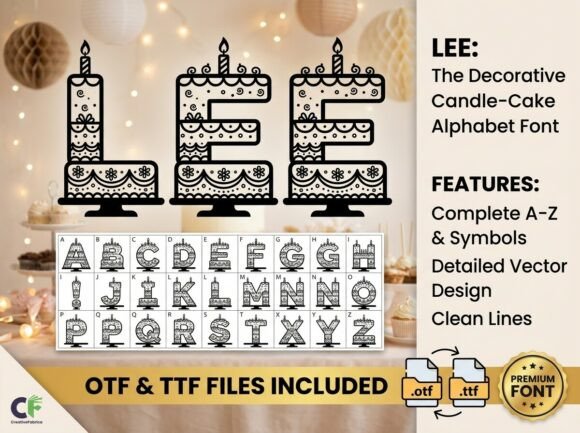
When you type a letter and a fully frosted, candle-lit birthday cake appears on your screen, you aren't just choosing a typeface; you are selecting an instant atmosphere. Lee is a decorative display font that reimagines the alphabet as a series of tiered confections, each character resting on a classic cake stand with meticulous vector detailing. Unlike standard novelty fonts that sacrifice legibility for gimmicks, Lee balances whimsical illustration with clean, high-quality lines. This balance makes it a functional design tool rather than just a visual curiosity. For designers, bakers, and event planners, Lee solves a specific problem: how to communicate "celebration" without relying on stock photography or clip art.
Elevating Bakery Branding and Packaging
For bakery owners and pastry chefs, typography often struggles to match the artisanal quality of the product. Standard serif or sans-serif fonts can feel too corporate for a boutique patisserie, while handwritten scripts can sometimes lack the structural weight needed for packaging. Lee bridges this gap by embodying the craft of baking within the letterforms themselves.
Consider the practical application on a menu board or a window decal. When a customer sees the word "BIRTHDAY" spelled out in Lee, the intricate piping and frosting patterns reinforce the skill involved in actual cake decoration. It creates a subconscious link between the graphic design and the culinary artistry. This font works exceptionally well for:
- Seasonal Menu Headers: Distinguishing special occasion items from daily offerings without using color coding or boxes.
- Packaging Stickers: Creating a premium unboxing experience where the label feels as decorative as the ribbon.
- Social Media Announcements: Stopping the scroll with text that looks like an illustration, increasing engagement on new flavor launches or holiday specials.
The vector quality of Lee ensures that whether it is printed on a small cupcake topper or a large storefront banner, the delicate frosting details remain crisp. This scalability is vital for businesses that need consistent branding across physical and digital touchpoints.
Personalized Invitations and Event Stationery
In the realm of DIY event planning and professional stationery design, the search for unique typography often leads to overused calligraphy. Lee offers a distinct alternative for milestone events where the theme is joy and indulgence. Because every letter is a standalone illustration, the font naturally dictates the layout and spacing of an invitation.
Designers should approach Lee as a modular building block. Rather than setting long paragraphs, use it for names, dates, and key phrases. A first birthday invitation featuring the child’s name in Lee instantly communicates the party theme before the guest even reads the details. For adult milestones, such as 30th or 50th birthdays, the nostalgic cake stand aesthetic adds a layer of vintage charm that avoids feeling juvenile.
Practical observation suggests pairing Lee with a simple, neutral sans-serif for body text. The visual weight of the cake letters is significant; competing it with another ornate font creates clutter. Let Lee be the focal point. This contrast not only improves readability but also highlights the decorative nature of the display font, making the essential information pop against the celebratory backdrop.
Digital Content and Social Media Graphics
Content creators and social media managers face the constant challenge of creating thumb-stopping visuals quickly. Lee serves as an all-in-one asset for festive content creation. Instead of spending hours sourcing royalty-free cake images and masking them into text, typing with Lee generates custom, cohesive graphics in seconds.
This efficiency is particularly valuable for community managers handling multiple accounts or influencers creating daily stories. The font’s inherent festivity reduces the need for additional decorative elements. A simple solid color background with a headline in Lee is often sufficient to convey excitement. However, the true power lies in its versatility across different digital formats:
- Instagram Stories: Use individual letters as interactive stickers or poll backgrounds.
- YouTube Thumbnails: High-contrast cake letters improve click-through rates for celebration-themed videos.
- Email Marketing: Break up text-heavy newsletters with celebratory headers that render consistently across email clients (when used as images).
Because Lee is vector-based, it exports beautifully as transparent PNGs or SVGs for web use. This technical advantage means no jagged edges or pixelation, maintaining a professional aesthetic even in fast-paced digital environments.
Navigating Legibility and Design Constraints
While Lee is undeniably charming, treating it like a standard text font will lead to design failures. Understanding its limitations is just as important as appreciating its strengths. The primary consideration is readability. The intricate frosting patterns and candle flames add visual noise that can make rapid reading difficult. Therefore, Lee should never be used for body copy, instructions, or fine print.
Spacing is another critical factor. Since each character sits on a cake stand, the horizontal footprint is wider than average. Kerning (adjusting space between characters) requires a gentle touch. Tightening the spacing too much causes the cake stands to overlap awkwardly, while spacing them too far apart breaks the word shape. Finding the "sweet spot" usually involves slightly looser tracking than you would use for a standard display font to allow each cake to breathe.
Color choice also impacts performance. While the font includes detailed line work, it shines best when filled with colors that mimic real frosting—pastels, creams, and vibrant primaries. Using dark colors on dark backgrounds can obscure the delicate piping details. Conversely, white-on-white embossing effects can look stunning for luxury wedding stationery but may fail on low-resolution screens. Always test your color combinations at the final output size to ensure the decorative elements remain distinct.
Strategic Pairing and Hierarchy
To maximize the impact of Lee, think about typographic hierarchy. It is a loud, expressive voice in a design composition. If everything is shouting, nothing is heard. Successful applications of Lee rely heavily on supportive secondary typefaces.
A geometric sans-serif provides a modern counterpoint that grounds the whimsy of the cakes. Alternatively, a clean monoline script can add a personal touch without competing for attention. The goal is to create a conversation between the decorative and the functional. For example, on a party favor tag, "THANK YOU" might be set in Lee, while the guest's name and table number are set in a legible serif. This distinction guides the eye and ensures the decorative element enhances rather than obstructs communication.
Ultimately, Lee is more than a novelty; it is a specialized tool for emotional communication. It transforms standard alphanumeric characters into symbols of hospitality and joy. Whether you are branding a high-end patisserie, designing a child’s birthday suite, or creating engaging social content, Lee offers a way to make every design feel like a milestone. By respecting its decorative nature and applying it with strategic restraint, you turn simple text into a party on a page.