Abby: Strategic Application of Character-Driven Display Typography
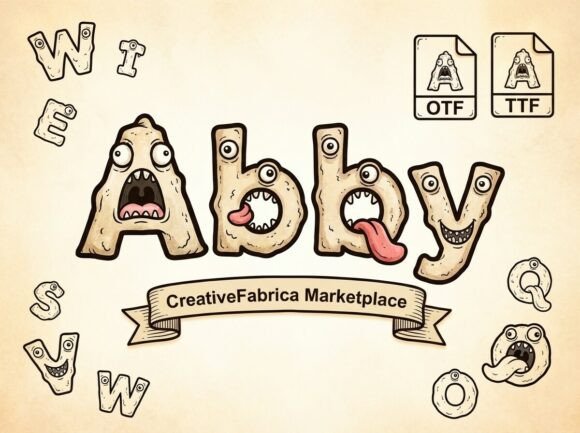
In the competitive landscape of visual communication, typography is rarely just about legibility; it is a primary vehicle for brand personality and emotional resonance. Abby represents a specific category of display typeface where the letterform itself serves as an illustration. Unlike standard serif or sans-serif fonts that prioritize neutrality and readability, Abby functions as a collection of distinct, monstrous characters featuring wide eyes, sharp teeth, and expressive tongues. For marketers, publishers, and product designers, understanding Abby requires shifting perspective from viewing text as mere information delivery to viewing it as active visual engagement.
The strategic value of Abby lies in its ability to bypass cognitive processing and trigger immediate emotional association. When a consumer encounters this font, they are not reading words so much as interacting with a cast of kooky, hand-drawn creatures. This makes Abby a high-impact tool for specific verticals, particularly children’s media, seasonal retail, and playful consumer goods. However, because the font carries such heavy stylistic baggage, it demands intentional deployment. Using Abby without a clear understanding of its psychological weight can lead to brand dissonance or accessibility failures. Successful implementation requires treating the typeface as a strategic asset rather than a decorative afterthought.
Aligning Typographic Personality with Audience Expectations
Before integrating Abby into a project, decision-makers must validate that the font’s inherent energy aligns with the target demographic’s expectations. Abby is inherently informal, chaotic, and juvenile. It signals safety through humor, transforming potentially scary monster tropes into lovable, goofy entities. This duality is its greatest strength in niche markets but its greatest liability in general contexts.
For children’s book titles and educational materials, Abby supports literacy by turning reading into a character-driven experience. The "living" nature of the letters encourages interaction, making the act of decoding text feel like play. In this context, the font supports learning outcomes by reducing the intimidation factor of complex vocabulary. Similarly, in toy packaging, Abby acts as a shelf-screener. Amidst rows of sterile, corporate typography, the wagging tongues and sharp teeth create a tactile visual promise of fun. The font tells the parent and child exactly what the product experience will be before they read a single descriptor.
However, this alignment must be precise. If your brand positioning relies on trust, stability, or premium sophistication, Abby will actively undermine your goals. Even within the "fun" category, there are gradations. Abby works best for brands that are zany, energetic, and slightly subversive. It is less effective for brands aiming for soft, gentle, or minimalist aesthetics. Conducting a visual audit of competitor assets is essential; if the market is saturated with similar quirky monster fonts, Abby may fail to differentiate. Conversely, if competitors rely on safe, generic rounded sans-serifs, Abby offers a significant opportunity for distinctiveness.
Operational Considerations for Hand-Drawn Display Fonts
Integrating a character-heavy font like Abby introduces operational variables that standard typography does not. Because every glyph is essentially a unique illustration, consistency and spacing become complex challenges. Designers cannot simply set type and expect professional results; they must treat each word mark as a custom logo design requiring manual adjustment.
- Kerning and Spacing: The irregular shapes of Abby’s characters often result in awkward negative space. Automated kerning tables rarely account for the extreme protrusions of tongues or horns. Budget time for optical adjustments to ensure the text feels cohesive rather than disjointed.
- Hierarchy Management: Abby is a headline font. It lacks the structural integrity required for body copy. Attempting to use it for paragraphs, captions, or fine print will destroy readability and frustrate users. Establish a strict typographic hierarchy where Abby is reserved exclusively for top-level attention grabbers, paired with a highly legible neutral companion font for supporting content.
- Scalability Testing: Intricate details like eyes and teeth can disappear at small sizes or bleed together in large-format printing. Test Abby across all intended touchpoints—from mobile app icons to trade show banners—before finalizing assets. What looks charming on a desktop screen may become illegible noise on a product tag.
- Licensing Compliance: Character fonts often have more restrictive licensing terms than standard typefaces due to their illustrative nature. Verify whether your license covers commercial merchandise, digital embedding, or broadcast use. Assuming standard OFL or desktop license applicability can expose businesses to legal risk.
Mitigating Accessibility and Inclusivity Risks
A critical strategic consideration when using Abby is accessibility. Highly stylized display fonts frequently fail WCAG (Web Content Accessibility Guidelines) standards for text contrast and character recognition. Users with dyslexia, low vision, or cognitive processing differences may find the irregular shapes and decorative elements confusing or exclusionary.
To mitigate this risk, never use Abby for functional navigation, instructions, or essential information. Its role should be strictly atmospheric or titular. Always provide alternative text descriptions that convey the semantic meaning of the headline without relying on the visual style. In digital environments, consider using Abby only as a background image or SVG with proper ARIA labels, while keeping actual HTML text in an accessible system font. This approach preserves the visual impact for sighted users while ensuring compliance and inclusivity for all audiences. Ignoring this aspect transforms a creative choice into a potential liability, alienating segments of your audience and exposing the organization to criticism regarding digital equity.
Strategic Use Cases and Long-Term Brand Value
When deployed correctly, Abby contributes to long-term brand equity by creating memorable visual anchors. The key is restraint and context. Below are strategic frameworks for maximizing the return on investment when utilizing this typeface.
Seasonal and Campaign-Specific Activation
One of the safest and most effective strategies for Abby is temporal limitation. Rather than adopting it as a permanent brand pillar, use it as a campaign-specific asset. Halloween party decor, summer camp promotions, and holiday gift guides are natural habitats for this aesthetic. By associating Abby with specific events, you prevent brand fatigue and maintain the font’s novelty. This approach also allows established brands to experiment with a playful tone without permanently altering their core identity. The font becomes a signal of celebration rather than a redefinition of the company.
Product Line Differentiation
For companies with diverse portfolios, Abby can serve as a visual differentiator between product tiers. A publishing house might use clean serifs for adult fiction and Abby for its middle-grade horror-comedy imprint. A food manufacturer might reserve it for a limited-edition kids' snack line while maintaining standard packaging for family products. This segmentation helps consumers instantly identify the intended audience and price point. It reduces cognitive load at the point of sale and reinforces the architecture of the brand portfolio. The decision to use Abby should always be tied to a specific product strategy, not just a designer’s preference for quirky aesthetics.
Evaluating ROI Through Engagement Metrics
How do you measure the success of a typographic choice? While direct attribution is difficult, proxy metrics can indicate whether Abby is performing strategically. For digital assets, monitor click-through rates on headlines using Abby versus control variants. For physical products, track sales velocity during periods where Abby-dominant packaging is on shelf compared to previous iterations. In social media, analyze sentiment and share rates; does the playful typography correlate with higher organic engagement?
If metrics stagnate or decline, the issue may not be the font itself but its application. Perhaps the color palette clashes with the monster aesthetic, or the companion font creates visual tension. Treat typography as a testable variable in your marketing mix. A/B testing headline treatments can reveal whether the "goofy energy" translates to conversion or merely distraction. Data-informed design decisions separate professional practice from subjective decoration.
Making the Final Decision: Intentionality Over Trend
Ultimately, the decision to use Abby should stem from a clear problem statement. Are you trying to soften a scary topic for children? Do you need to stand out in a crowded retail environment? Is your brand voice authentically zany, or are you borrowing someone else’s personality? If the answer is rooted in solving a communication challenge, Abby is a powerful tool. If the answer is simply "it looks cool," proceed with caution.
Sustainable design systems are built on purpose. Abby brings a hand-drawn, living quality that few other typefaces can match, but that specificity is a double-edged sword. It demands a supportive ecosystem of complementary visuals, rigorous accessibility planning, and clear strategic boundaries. By approaching Abby as a specialized instrument rather than a universal solution, creators can unleash its fun, creative potential while maintaining professional standards and achieving measurable business outcomes. The goal is not just to make text look like monsters, but to make the message resonate with the humans reading it.