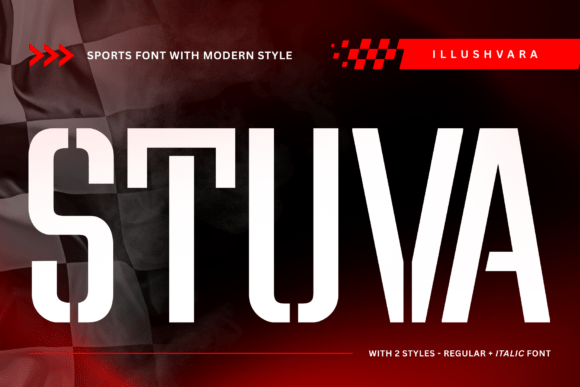
Stuva Sports: Engineering Visual Impact for Modern Athletic Branding
In the competitive landscape of sports marketing and automotive design, typography is rarely just about legibility; it is about transmitting kinetic energy through static media. Designers working in these high-intensity sectors face a unique challenge: how to convey speed, power, and forward momentum without relying on clichéd imagery or overused typefaces. This is where Stuva Sports establishes its relevance. As a modern sans serif font engineered specifically for bold expression, it addresses the growing demand for type that performs as an active visual element rather than a passive container for text.
The shift toward specialized display fonts like Stuva Sports reflects a broader evolution in digital and print branding. Audiences today process visual information faster than ever before, particularly in mobile-first environments and social media feeds. A standard geometric sans serif often lacks the aggressive character required for racing liveries, gym apparel, or esports team identities. By utilizing an all-caps format paired with unique ligatures, Stuva Sports provides a solution that aligns with current market preferences for distinct, ownable brand assets that communicate strength instantly.
The Evolution of Dynamic Typography in Performance Industries
Historically, sports typography leaned heavily on slab serifs or exaggerated italics to suggest motion. While effective in their era, these styles have become saturated. The modern aesthetic has shifted toward cleaner, more futuristic forms that mirror advancements in athletic technology and automotive engineering. Just as vehicle aerodynamics have become sleeker and more integrated, typographic trends have moved toward streamlined geometry that suggests efficiency alongside power.
Stuva Sports fits directly into this trajectory. It abandons the retro nostalgia of mid-century athletic lettering in favor of a contemporary structure that feels native to the 2020s. This evolution matters because consumer expectations have changed. Fans and customers associate modernity with performance. When a brand uses outdated typography, it subconsciously signals legacy rather than innovation. For professionals creating identities for new leagues, fitness tech startups, or motorsport teams, selecting a typeface that embodies current design language is a strategic business decision, not merely an artistic preference.
Leveraging All-Caps Architecture for Maximum Presence
The decision to build Stuva Sports exclusively in an all-caps format is a deliberate functional choice. In the context of headlines, jersey numbers, and signage, uppercase letterforms provide a uniform vertical rhythm that maximizes spatial efficiency. Lowercase letters, with their ascenders and descenders, create uneven negative space that can dilute visual impact at a distance or on small screens. The monolinear height of an all-caps system creates a solid block of color and texture that commands attention.
However, all-caps typefaces often suffer from rigidity. Without careful design, they can appear monotonous or overly aggressive. Stuva Sports mitigates this through the inclusion of both Regular and Italic styles. The Regular weight serves as a stable anchor for primary logos and structural hierarchy, while the Italic variant introduces necessary dynamism. Unlike algorithmic slants applied to existing fonts, a true italic in a sports typeface adjusts the internal geometry of the glyphs to maintain legibility while enhancing the sensation of velocity. This duality allows designers to create complex hierarchies within a single type family, essential for cohesive branding across merchandise, digital platforms, and environmental graphics.
Strategic Use of Ligatures in Futuristic Design
One of the most defining features of Stuva Sports is its extensive library of unique ligatures. In traditional typography, ligatures exist primarily to resolve spacing issues between specific letter pairs. In the realm of sports and automotive identity, however, they serve a different purpose: customization and futurism. These connected forms transform standard text into bespoke logotypes, reducing the need for manual vector manipulation and ensuring consistent kerning across different applications.
For freelancers and agency designers, this feature significantly streamlines workflow. Creating a custom wordmark typically involves hours of adjusting anchor points and bezier curves. With Stuva Sports, the stylistic alternatives are baked into the OpenType programming. This allows for rapid iteration during client presentations and ensures that the final deliverable maintains typographic integrity. The ligatures introduce a sleek, interconnected aesthetic that mirrors the precision engineering found in high-performance vehicles and professional athletic gear. They turn ordinary words into graphical symbols, increasing the memorability of the brand name.
- Logo Development: Utilize ligatures to lock up team names or brand titles into compact, iconic shapes suitable for favicons, app icons, and helmet decals.
- Apparel Design: Apply alternating ligature treatments to create texture and pattern on jerseys and training wear without introducing external graphic elements.
- Social Media Assets: Use the distinctive connections to make headline text stand out in crowded feeds, improving click-through rates and engagement.
- Environmental Signage: Leverage the bold, connected forms for wayfinding and stadium graphics where instant recognition is critical for safety and navigation.
Practical Applications Across Media and Merchandise
The versatility of Stuva Sports extends beyond digital screens. Its robust construction makes it exceptionally well-suited for physical production methods common in the sports industry. Screen printing, embroidery, vinyl cutting, and laser etching all require typefaces with clear counters and sturdy strokes. Thin, delicate serifs or overly complex scripts often fail in these mediums, resulting in broken lines or illegible text after washing or wear. The solid geometry of Stuva Sports ensures reproduction fidelity across diverse substrates, from polyester performance fabrics to matte-finish carbon fiber.
For entrepreneurs and business owners in the fitness or automotive space, this durability translates to cost savings and brand consistency. There is no need to maintain separate "print-safe" and "web-safe" versions of your primary typeface. Stuva Sports performs reliably whether it is embroidered at two inches on a polo shirt or printed at twenty feet on a race car trailer. This cross-media reliability is crucial for building trust. When a brand looks polished and professional in every touchpoint, it reinforces perceptions of quality and competence.
Aligning Typography with User Expectations and Market Trends
We are currently witnessing a convergence of lifestyle and performance culture. Fitness is no longer just about utility; it is a fashion statement. Automotive enthusiasm has merged with streetwear aesthetics. Consequently, the typography used in these spaces must bridge the gap between technical specification and lifestyle aspiration. Stuva Sports succeeds because it balances mechanical precision with stylistic flair. It reads as authoritative enough for a technical spec sheet yet stylish enough for a limited-edition sneaker collaboration.
This alignment with cultural trends is vital for marketers targeting the 20–50 demographic. This audience values authenticity and craftsmanship. They can distinguish between generic clip-art aesthetics and thoughtful design. Using a specialized tool like Stuva Sports demonstrates an investment in quality. It signals that the brand understands the nuances of the subculture it serves. In an era where AI-generated content and template-based design are ubiquitous, intentional typographic choices act as a marker of human creativity and professional standards.
Optimizing Workflow for Modern Creative Teams
Beyond aesthetics, the adoption of specialized fonts like Stuva Sports addresses practical workflow challenges. Creative teams are often tasked with producing high volumes of content under tight deadlines. Having a typeface that offers built-in variety through ligatures and stylistic sets reduces dependency on secondary fonts. It simplifies asset management and ensures visual coherence across campaigns. Instead of juggling three or four different display faces to achieve variety, a designer can extract multiple distinct looks from a single, cohesive system.
Furthermore, the strong personality of Stuva Sports reduces the cognitive load during the concept phase. When the typeface itself carries significant emotional weight, less effort is required to prop it up with supporting graphics. The font does the heavy lifting, allowing designers to focus on layout, photography, and messaging. This efficiency is particularly valuable for freelancers and small studios where time is directly correlated with profitability. By choosing tools that are fit for purpose, creatives can deliver higher-value work in less time.
Ultimately, typography is the voice of visual communication. In sectors defined by adrenaline, competition, and innovation, that voice needs to be loud, clear, and unmistakably modern. Stuva Sports offers a refined instrument for professionals who understand that in sports and automotive design, style is never superficial—it is integral to the message. Whether you are rebranding a local racing team, launching a new line of athletic wear, or designing a poster for an upcoming tournament, the right typeface bridges the gap between concept and impact. By integrating Stuva Sports into your creative toolkit, you equip yourself with the typographic horsepower necessary to keep pace with the demands of modern performance branding.