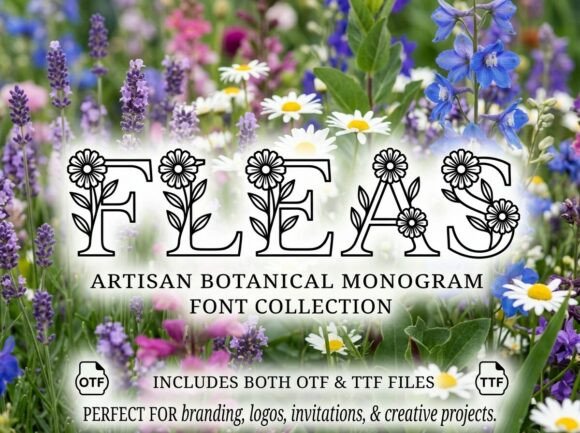
Fleas: Cultivating a Garden of Creativity with Botanical Typography
Selecting the right typeface for a nature-inspired project often feels like walking a tightrope between authentic charm and professional legibility. Fleas offers a distinct solution to this common design dilemma by functioning as an exquisite display serif that captures a natural-and-nurturing soul. Unlike standard botanical fonts that simply place clip art next to text, Fleas integrates rhythmic, hand-drawn daisies and delicate leaf stems directly into the structure of every character. This unique architecture bridges the gap between traditional botanical illustrations and modern cottagecore branding, making it a premier choice for independent artisanal soap packaging, boutique wildflower shop identities, personalized garden stationery, and high-impact verdant-and-vintage social media headers.
However, the very features that make Fleas so captivating also introduce specific usability challenges. Because the flora grows through the letterforms rather than sitting beside them, treating this typeface like a standard serif will inevitably lead to readability issues and visual clutter. To truly cultivate a garden of creativity without overgrowing your design, you must understand how to manage its organic complexity. The following insights address common missteps and provide practical corrections to ensure your typography blooms effectively.
Mistaking Display Ornamentation for Body Text Utility
The most frequent error designers and business owners make with Fleas is attempting to use it for extended reading passages. It is vital to remember that Fleas is strictly a display font. The intricate daisy motifs and weaving stems create significant visual noise at small sizes. When used for product descriptions, website body copy, or fine print on packaging, the botanical elements cease to be decorative accents and instead become obstructions that hinder comprehension.
This misuse affects more than just aesthetics; it impacts accessibility and user experience. A customer trying to read ingredient lists or care instructions should never have to decipher letters entangled in foliage. To avoid this, reserve Fleas exclusively for headlines, logos, short quotes, and hero images. Pair it with a clean, neutral sans-serif or a simple serif for supporting text. This contrast not only preserves legibility but also allows the ornate details of Fleas to stand out as intended, creating a balanced hierarchy that guides the viewer’s eye naturally.
Overlooking Contextual Spacing and Kerning Needs
Standard typography relies on consistent spacing, but organic typefaces require a different approach. A common oversight is applying default tracking and kerning settings to Fleas. Because the floral elements extend beyond the traditional bounding box of each glyph, default spacing can cause daisies to collide awkwardly or leave unnatural gaps that break the rhythm of the word. This mechanical rigidity contradicts the hand-drawn, nurturing aesthetic the font aims to convey.
To correct this, you must manually adjust spacing based on the specific word shape rather than relying on global metrics. Treat each headline as a custom illustration. You may need to tighten the space between certain pairs to allow a stem to tuck gracefully under a crossbar, or widen the gap elsewhere to let a flower breathe. This extra time investment transforms the text from a typed string into a cohesive botanical composition. For social media headers or shop signage, this bespoke attention to detail signals high-quality craftsmanship to your audience.
Neglecting Technical Reproduction Constraints
While Fleas looks stunning on a high-resolution screen, its delicate lines present tangible risks in physical production. Many creators fall in love with the digital preview only to face disappointment when the fine leaf stems disappear during printing or embroidery. Thin serifs and hairline botanical details are particularly vulnerable to ink spread on uncoated paper or thread tension in textiles. If you are designing artisanal soap wrappers or fabric tags, assuming the digital file will translate perfectly is a costly mistake.
Before finalizing any physical application, conduct rigorous material testing. Request a proof print on your exact paper stock to check if the thinnest stems hold up or fill in with ink. For embroidered merchandise, consult with your digitizer early; Fleas may require simplification or stroke thickening to be viable for stitching. In some cases, you might need to select a heavier weight of the font or slightly modify the vector paths to accommodate the limitations of your chosen medium. Proactive adaptation ensures the final product retains the elegance of the original design without looking muddy or broken.
Misaligning Brand Voice with Visual Tone
Fleas carries a specific emotional weight that does not suit every "green" or "natural" brand. A misunderstanding here leads to tonal dissonance. For example, a clinical skincare line focused on dermatological science might find the whimsical daisies too informal or juvenile, while a rugged outdoor gear company might find the delicate stems too fragile. Using Fleas simply because it contains plants ignores the nuance of its personality, which leans specifically toward vintage, soft, and domesticated nature rather than wild or scientific botany.
Evaluate your brand voice critically before adoption. Fleas excels in contexts that value nostalgia, handmade warmth, and gentle sophistication. It is ideal for wedding stationery, heritage bakeries, and floral studios. If your brand identity is minimalist, futuristic, or aggressively bold, this typeface may undermine your message despite its botanical relevance. Always view the font within the context of your complete visual system—colors, photography style, and layout—to ensure it reinforces rather than conflicts with your intended narrative.
Ignoring Licensing Nuances for Commercial Use
In the excitement of discovering a perfect font, many entrepreneurs overlook the specific terms of use. Fleas is a specialized creative asset, and licensing for commercial applications like product packaging or monetized social media templates often differs from personal desktop licenses. Assuming that purchasing the font grants unlimited rights across all platforms can expose small businesses to legal risks or unexpected costs later.
Review the End User License Agreement (EULA) with the same care you apply to your design work. Check specifically for clauses regarding logo usage, web embedding, and merchandise reproduction. Some licenses cap the number of impressions or units sold, requiring upgrades as your business scales. Clarifying these details upfront prevents disruptions down the road. Furthermore, respecting the creator’s terms supports the independent type design ecosystem, ensuring that unique voices like Fleas continue to flourish in a market often dominated by generic alternatives.
Failing to Optimize for Digital Accessibility
When using Fleas for social media headers or website banners, creators sometimes prioritize beauty over function. Highly decorative text can be difficult for screen readers to interpret and challenging for users with visual impairments to parse. Relying solely on the visual rendering of Fleas without providing accessible alternatives excludes part of your audience and can negatively impact SEO performance.
Always include descriptive alt text for images containing Fleas typography. On websites, ensure that headings marked up with this font have plain-text equivalents or are implemented via CSS in a way that remains accessible to assistive technology. Additionally, maintain sufficient color contrast between the intricate letterforms and the background. The detailed internal counter spaces of Fleas can reduce perceived contrast, so opt for solid, dark backgrounds or light text on dark fields to maximize clarity. By integrating accessibility into your creative process, you ensure that your garden of creativity is welcoming to everyone.
Ultimately, Fleas is more than a collection of letters; it is a stylistic commitment to a specific kind of beauty. By avoiding these common pitfalls and approaching the typeface with technical mindfulness and strategic intent, you can harness its full potential. Whether you are wrapping handmade soaps or designing a vibrant Instagram feed, thoughtful application ensures that Fleas enhances your work with genuine, nurturing elegance rather than mere decoration.