Fastrek: Elevating Automotive and Motorsport Design with High-Impact Typography
In the competitive world of motorsport branding and automotive marketing, visual communication must operate at the same velocity as the vehicles it represents. Designers and brand managers frequently face a specific challenge: finding typography that conveys speed, power, and technical precision without sacrificing legibility or professional polish. Generic bold fonts often feel static, while overly stylized racing scripts can become unreadable at a glance. Fastrek addresses this critical gap in the design toolkit. It is a modern racing display font engineered specifically to deliver a bold competitive look, bridging the divide between aggressive aesthetics and functional clarity.
Solving the Velocity vs. Legibility Dilemma
The primary obstacle in automotive graphic design is balancing kinetic energy with information hierarchy. When creating content for high-speed environments—whether on a pit lane banner, a digital dashboard interface, or merchandise viewed from a distance—the typeface must perform instantly. If the audience cannot read the message within a fraction of a second, the design has failed its purpose.
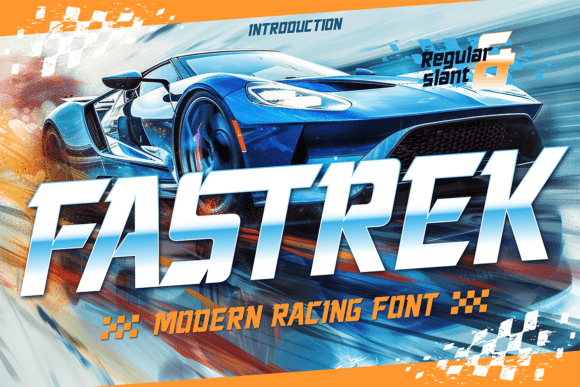
Fastrek was built to solve this friction point. Inspired directly by motorsport culture and futuristic racing visuals, the typeface utilizes sharp angles and strong geometry to create an inherent sense of motion. However, unlike novelty fonts that prioritize style over substance, Fastrek maintains high legibility. This ensures that your headlines remain impactful and readable even when scaled down for social media graphics or scaled up for large-format vehicle wraps. The font’s structure allows designers to inject adrenaline into their layouts without compromising the user's ability to process key information quickly.
Versatility Through Dual Style Options
A common limitation in niche display fonts is a lack of variation. Designers often find themselves locked into a single aesthetic that may not suit every application within a comprehensive campaign. Fastrek mitigates this issue by providing two distinct styles: Regular and Slant. This duality offers practical flexibility for complex branding systems.
- Regular Style: This variation provides a clean, solid, and authoritative appearance. It is ideal for subheadings, technical specifications, or areas where stability and trust are paramount. The geometric foundation remains, but the upright posture grounds the design, offering a necessary visual anchor against more chaotic imagery.
- Slant Style: Designed for maximum aggression and pace, the slanted variant mimics the aerodynamic profile of high-performance cars. This style is best utilized for primary headlines, call-to-action buttons, and dynamic overlays where the goal is to simulate forward momentum.
By having both options available within a single family, you can establish a cohesive visual language that adapts to different contexts. You might use the Slant style for the main event title on a poster to grab attention, while employing the Regular style for the date, venue, and sponsor details to ensure clarity. This internal consistency strengthens brand recognition while allowing for nuanced emotional adjustments across various touchpoints.
Practical Applications Across Media
Understanding where and how to implement Fastrek is essential for maximizing its effectiveness. The font’s characteristics make it particularly suited for several high-stakes design scenarios.
Vehicle Livery and Wrap Design
When designing for car liveries, typography must contend with curved surfaces, varying viewing distances, and complex background patterns. Fastrek’s strong geometry holds up exceptionally well against the organic lines of automotive bodywork. The sharp angles complement the mechanical nature of the vehicle, while the bold weight ensures the text remains visible through glare, dirt, and motion blur. For racing teams, using the Slant variant can visually reinforce the car’s aerodynamic efficiency, making the vehicle appear faster even when stationary.
Digital Content and Social Media
In the digital space, attention spans are measured in milliseconds. Thumbnails, Instagram stories, and YouTube titles require typography that stops the scroll. Fastrek’s energetic character serves as an effective hook. Because the letterforms are distinct and open, they render crisply on screens of all resolutions. When pairing this font with video content or photography, consider using high-contrast color combinations to leverage the font’s bold silhouette, ensuring the text pops against busy race track backgrounds or detailed engine shots.
Merchandise and Apparel
Fans and consumers wear racing gear to signal identity and passion. Typography on apparel needs to feel authentic to the subculture. Fastrek avoids the cliché look of generic "sporty" fonts, offering instead a premium, futuristic aesthetic that aligns with modern motorsport trends. Whether screen-printed on a t-shirt or embroidered on a cap, the font’s confident strokes translate well to physical production methods, maintaining integrity across different manufacturing constraints.
Strategic Considerations for Different Users
Different stakeholders approach typography selection with varying priorities. Recognizing these differences helps in deploying Fastrek more effectively.
Brand Managers should view Fastrek as a tool for positioning. If the goal is to modernize a legacy racing team or launch a new performance product line, this font signals innovation and forward-thinking engineering. It moves the brand away from nostalgic or traditional serif-based racing aesthetics toward a contemporary, tech-forward identity.
Graphic Designers will appreciate the font’s structural reliability. When working under tight deadlines for event materials, having a typeface that naturally commands attention reduces the need for excessive effects like drop shadows or outlines. Fastrek does the heavy lifting through its form alone, streamlining the workflow and resulting in cleaner, more professional compositions.
Content Creators and Marketers should focus on the emotional resonance. The font acts as a non-verbal cue that primes the audience for excitement. When used in advertising copy or video intros, it sets a tone of intensity before a single word is read. Pairing Fastrek with sleek, minimalist sans-serif body text creates a balanced layout that feels both exciting and informative.
Implementation Best Practices
To get the most out of Fastrek, adhere to a few implementation guidelines rooted in typographic best practices for display faces.
- Respect the Hierarchy: As a display font, Fastrek is optimized for headlines and short statements. Avoid using it for long paragraphs or dense body copy. Its bold personality can overwhelm extended reading experiences. Reserve it for titles, numbers, and key phrases.
- Mind the Spacing: Racing fonts often benefit from tight tracking to enhance the feeling of speed and cohesion. However, be cautious not to let the letters touch unless intentional. Test spacing at actual output size to ensure individual characters remain distinct.
- Contrast is Key: Fastrek thrives when paired with neutral, highly legible typefaces for supporting text. The contrast between the dynamic display font and a stable geometric sans-serif creates a professional tension that guides the viewer’s eye effectively.
- Contextual Alignment: Always consider the background environment. On a vehicle wrap, account for panel gaps and door handles. In digital ads, ensure safe zones for platform UI elements. The font’s sharp edges should align with or intentionally counterpoint the structural lines of the medium.
Ultimately, typography in the automotive sector is about translating mechanical performance into visual language. Fastrek provides a specialized solution for designers who need to communicate speed, confidence, and modernity. By understanding its dual styles, respecting its display-focused nature, and applying it strategically across physical and digital mediums, you can create designs that don't just sit on the page—they race.