Cute Snail: Evaluating a Chunky Bubble Display Font for Playful Design
In the competitive landscape of display typography, finding a typeface that balances visual impact with genuine approachability is a specific challenge for designers targeting younger demographics. Cute Snail enters this space as a chunky bubble display font that draws direct inspiration from organic, natural forms. Rather than relying on sharp geometric precision or rigid grid structures, this typeface utilizes oversized, interlocking letterforms to create a sense of monumental fun. For professionals working in children’s publishing, educational technology, or youth-oriented branding, understanding the functional mechanics and aesthetic limitations of Cute Snail is essential for determining its viability in commercial projects.
Defining the Organic Bubble Aesthetic
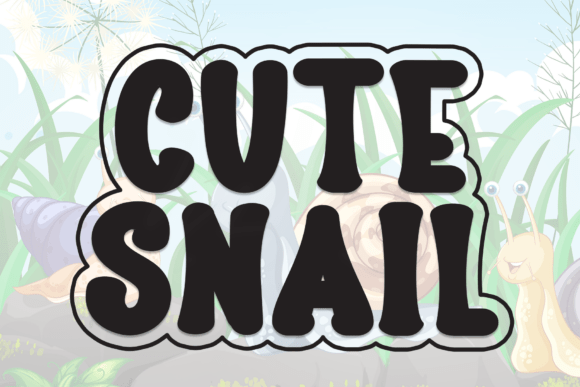
Cute Snail distinguishes itself through a heavy visual weight paired with smooth, continuous curves. The design philosophy moves away from traditional typographic contrast, opting instead for a uniform stroke width that mimics the tactile quality of inflated balloons or soft clay. This "jumbo" aesthetic is not merely a stylistic choice but a functional one; the increased x-height and expanded counters ensure legibility even when the font is scaled down for packaging or mobile interfaces.
The defining characteristic of this typeface is its interlocking nature. Unlike standard sans-serif fonts where spacing is mathematically distributed to prevent collision, Cute Snail encourages letters to nestle against one another. This creates a cohesive word shape rather than a series of isolated characters. For designers, this means the font performs best when treated as a graphical element rather than a vessel for dense information. The organic curves soften the overall composition, making the text feel less authoritative and more inviting, which is a critical psychological cue for audiences in early childhood development stages.
Practical Applications and Industry Fit
While novelty fonts often suffer from limited utility, Cute Snail demonstrates specific strengths in verticals that require high engagement and low cognitive friction. Its primary value proposition lies in its ability to communicate safety, playfulness, and creativity instantly.
- Children’s Book Titles and Covers: In publishing, the title treatment must compete with vibrant illustrations. Cute Snail provides sufficient mass to anchor a cover layout without introducing aggressive angles that might clash with hand-drawn artwork. Its friendly tone aligns with the narrative expectations of picture books and early readers.
- Educational Gaming Logos: EdTech and gaming interfaces for children require typography that feels rewarding and non-intimidating. The rounded terminals and bubbly structure of Cute Snail reduce the perceived difficulty of learning tasks, making it an effective choice for app icons, level headers, and achievement badges.
- Toy Packaging and Retail: On physical shelves, readability at a glance is paramount. The heavy weight of Cute Snail ensures high contrast against busy packaging backgrounds. Furthermore, the playful aesthetic signals age-appropriateness to parents and guardians scanning aisles quickly.
- Social Media Graphics: For digital campaigns targeting families or promoting youth events, standard bold sans-serifs can sometimes appear too corporate. Cute Snail offers a distinct alternative that stops the scroll by breaking the pattern of clean, minimalist feeds with something texturally different.
Technical Considerations and Workflow Integration
Integrating Cute Snail into a professional workflow requires an understanding of its technical behavior. Because the letterforms are designed to interlock, standard tracking adjustments can sometimes disrupt the intended rhythm of the typeface. Designers should exercise caution when manually kerning; excessive spacing can break the organic connections between characters, while overly tight spacing may cause ink traps or rendering issues at smaller sizes.
The font’s heavy weight also demands careful attention to negative space. When setting headlines in Cute Snail, the surrounding whitespace becomes an active part of the design. Crowding this typeface with other bold elements or complex textures can lead to visual vibration and reduced legibility. It functions most effectively when given room to breathe, allowing the unique silhouette of each word to register clearly.
From a production standpoint, the smooth curves of Cute Snail generally render well across screen resolutions, provided the vector points are clean. However, designers preparing files for print should verify that the rounded terminals maintain their integrity during the RIP process, especially on uncoated papers where ink spread could potentially close up the already generous counters. Testing on the intended output medium is always recommended for display fonts with such specific morphological traits.
Evaluating Versatility and Limitations
A realistic assessment of Cute Snail must acknowledge its boundaries. As a specialized display font, it is not engineered for body copy, captions, or extended reading. Attempting to use it for paragraphs will result in poor readability and user fatigue due to the lack of typographic color variation and the overwhelming visual density of the forms.
Furthermore, the tone of Cute Snail is inherently informal. While this is an asset for toy brands and educational content, it renders the font unsuitable for sectors requiring gravitas, such as pediatric healthcare, legal services for families, or premium luxury goods for children. The "monumental fun" described in its brief translates to "lack of seriousness" in contexts where trust and authority are the primary communication goals. Professionals must evaluate whether the brand voice aligns with the font’s intrinsic personality before adoption.
Another consideration is longevity. Bubble fonts have cyclical popularity in design trends. While Cute Snail’s organic inspiration gives it a timeless quality compared to purely geometric bubble letters, it still carries a strong stylistic signature. Projects intended to remain evergreen for decades may need to pair Cute Snail with a more neutral supporting typeface to ensure the overall identity does not feel dated as trends shift. Using it as an accent rather than the sole typographic pillar can extend the shelf life of a brand system.
Strategic Value for Creative Professionals
For freelancers, agency designers, and in-house creatives, adding Cute Snail to the toolkit represents an investment in niche capability. It solves a specific problem: how to make large-scale text feel soft and safe without sacrificing presence. In a market saturated with variable geometric sans-serifs and retro serifs, having access to a high-quality, organically inspired display font allows for greater differentiation in pitches and final deliverables.
The font’s effectiveness ultimately depends on restraint and context. It is a tool for emphasis, not exposition. When used appropriately—restricted to headlines, logos, and short callouts—Cute Snail delivers on its promise of approachable power. It transforms standard messaging into a visual experience that resonates emotionally with younger audiences while satisfying the practical requirements of commercial design.
Professionals evaluating this resource should view it through the lens of audience psychology. Does the project require a sense of wonder? Is the goal to lower barriers to entry for a young user? If the answer is yes, Cute Snail offers a reliable, aesthetically consistent solution. If the project demands neutrality or high information density, other typographic choices will serve better. Understanding these distinctions ensures that the font remains a valuable asset rather than a decorative afterthought.
Making the Final Decision
Selecting typography is rarely about personal preference alone; it is a strategic business decision. Cute Snail earns its place in professional portfolios by executing a specific aesthetic function with technical competence. Its interlocking forms, heavy weight, and organic curves are not just stylistic flourishes but deliberate design decisions aimed at maximizing engagement in youth-centric markets. By respecting its limitations and leveraging its strengths in appropriate contexts, designers can utilize Cute Snail to create work that is both commercially effective and genuinely delightful. The font succeeds because it understands its audience, offering a tangible sense of joy that translates directly into brand affinity and user connection.