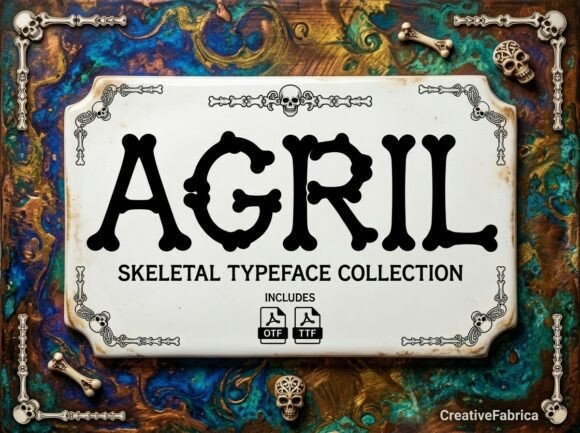
Agril: Elevating Creative Projects with a Bold Decorative Display Font
In the crowded landscape of digital design, finding a typeface that commands attention without screaming for it is a genuine challenge. Agril emerges as a distinct solution for creators who need their typography to do more than just convey information; it needs to set a mood. This decorative display font is engineered to be the centerpiece of any layout, offering a high-end aesthetic that balances artistic flair with professional restraint. Unlike versatile workhorse fonts meant for body copy, Agril is specialized. It is a tool for moments when standard sans-serifs feel too sterile and ornate scripts feel too messy.
Understanding what Agril actually is requires looking past generic descriptions of "bold" or "artistic." It is an all-caps display typeface designed specifically for impact. The letterforms possess strong character and distinct artistic elements that suggest craftsmanship rather than automated generation. For designers, marketers, and business owners, this distinction matters. When you choose Agril, you are selecting a visual voice that implies luxury, intentionality, and confidence. It breaks away from the ordinary not through gimmicks, but through deliberate structural choices that make headlines and logos feel substantial.
Strategic Applications in Branding and Packaging
The most immediate value of Agril lies in commercial branding, particularly for businesses positioning themselves in the premium or artisanal sectors. Consider a boutique skincare line launching a new serum. Using a standard geometric sans-serif might communicate cleanliness, but it often fails to communicate value. Agril bridges this gap. Its weight and texture on packaging labels suggest that the product inside has been curated with care. The font’s all-caps nature creates a uniform block of text that acts almost like a graphical element, making shelf presence stronger even at smaller sizes.
This same principle applies to hospitality and food service. A craft brewery or a high-end bistro updating their menu can use Agril for section headers or signature dish names. In these environments, readability is paramount, but so is atmosphere. Because Agril maintains clear legibility despite its decorative nature, it serves a dual purpose: it guides the customer’s eye through the menu hierarchy while reinforcing the establishment's brand identity. It tells the diner they are in a place that values detail before they have even ordered.
Digital Presence and Social Media Impact
In the digital realm, where users scroll rapidly, typography must arrest attention within milliseconds. Content creators and social media managers face the constant pressure of stopping the scroll. Agril functions exceptionally well here as a headline treatment for Instagram carousels, Pinterest pins, or YouTube thumbnails. The boldness of the typeface ensures it remains readable on mobile screens, which is often where decorative fonts fail. Thin lines disappear against busy backgrounds, but Agril’s solid construction holds up against photography and video overlays.
For bloggers and online educators, this font offers a way to create consistent visual branding across diverse content types. Instead of relying solely on color or imagery to signal a new post or course module, using Agril for titles creates a recognizable typographic signature. This consistency builds trust and recognition over time. When a subscriber sees that specific letterform in their feed, they associate it with your content before reading a single word. It transforms typography from a passive vessel for words into an active component of your marketing strategy.
Navigating the All-Caps Constraint
Before integrating Agril into a workflow, it is critical to address its defining technical characteristic: it is strictly an all-caps typeface. By design, it does not contain lowercase letters. This is not a limitation to be worked around, but a feature to be leveraged. Lowercase letters provide rhythm and variation that aid reading flow in long paragraphs. Without them, text becomes a uniform texture. Therefore, Agril should never be used for body copy, captions, or extended descriptions.
This constraint actually improves design outcomes by forcing better typographic hierarchy. When you cannot rely on case changes to distinguish a headline from subtext, you must use scale, spacing, and weight contrast more intentionally. Pairing Agril with a clean, neutral sans-serif or a highly legible serif for supporting text creates a dynamic tension that looks professionally designed. The all-caps format also makes Agril ideal for monograms, initials, and short, punchy taglines where symmetry and balance are more important than narrative flow.
Technical Versatility Across Platforms
Creatives rarely work in a single software environment. A logo designed in Adobe Illustrator eventually needs to appear on a Shopify store, a Word document proposal, or a Canva template for a client. Agril addresses this reality by including both OTF and TTF file formats. The OpenType (OTF) version is essential for professional designers working in advanced software. It supports sophisticated typographic features and ensures precise rendering in print production and high-resolution digital assets.
Conversely, the TrueType (TTF) file ensures accessibility for non-designers and cross-platform compatibility. Small business owners managing their own marketing materials, teachers creating classroom resources, or freelancers delivering editable templates to clients will appreciate this inclusion. TTF files install seamlessly on Windows and macOS without requiring specialized font management tools. This duality means that the visual identity established by a professional designer can be maintained accurately by stakeholders who may not have access to creative cloud subscriptions or advanced typography training.
Practical Considerations for Implementation
While Agril delivers a high-end aesthetic, successful implementation requires mindfulness regarding spacing and context. Display fonts of this nature often benefit from adjusted tracking (letter-spacing). Depending on the application, tightening the spacing can create a cohesive, logo-like lockup, while opening it up can evoke a more luxurious, editorial feel. Users should test multiple spacing configurations before finalizing a design, as the optimal setting varies significantly between a business card and a billboard.
Licensing and usage rights are another practical consideration for entrepreneurs and freelancers. Understanding whether the license covers commercial merchandise, web embedding, or client work is vital to avoiding legal pitfalls. Beyond legality, consider the longevity of the style. Agril’s strength is its distinct personality, which makes it perfect for campaigns, seasonal launches, and brand refreshes. However, because it is so expressive, it may date faster than a neutral typeface. Use it for elements you anticipate updating every few years, or for brands whose identity is inherently tied to being current and stylistically bold.
Ultimately, Agril serves those who understand that typography is a strategic asset. It is not merely decoration; it is a communication tool that signals quality and intent. Whether applied to luxury packaging, digital content headers, or educational materials, it provides the visual weight necessary to make a statement. By respecting its all-caps nature and pairing it thoughtfully with supporting typefaces, creators can harness its power to elevate projects from functional to memorable. The included file formats ensure that this elevation is accessible to everyone from the solo hobbyist to the agency art director, making professional-grade aesthetics achievable across the entire spectrum of creative work.